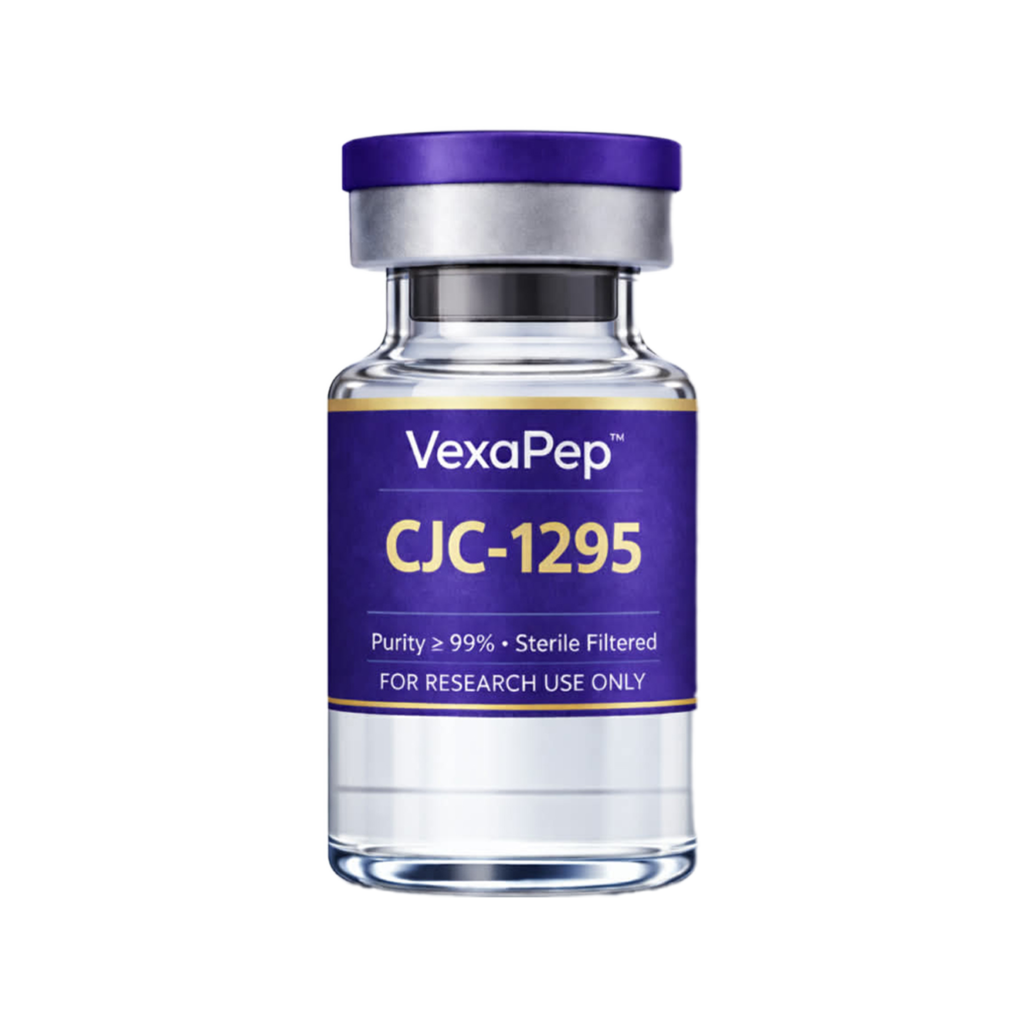
What is the CJC-1295 No DAC Peptide?
The CJC-1295 No DAC peptide (frequently referred to in scientific literature as Modified GRF 1-29) is an advanced synthetic secretagogue designed to replicate the native signaling architecture of human GHRH. By substituting four specific amino acids at positions 2, 8, 15, and 27, this molecule achieves vastly superior metabolic stability and resistance to rapid enzymatic cleavage by dipeptidyl peptidase-4 (DPP-4) compared to natural growth hormone-releasing hormone.
The primary mechanism of action of the CJC-1295 No DAC peptide relies on its highly selective binding to GHRH receptors on somatotroph cells within the anterior pituitary. Unlike versions incorporating a Drug Affinity Complex (DAC) which cause a continuous, un-pulsed leakage of growth hormone, the No DAC variant preserves the body’s natural, wave-like biological release layout. This makes it an invaluable chemical asset for researchers analyzing real-time cellular recovery spikes and isolated hormone tracking without disrupting endogenous homeostatic feedback loops.
Key Scientific Applications & Research Benefits
In laboratory models, musculoskeletal stress frameworks, and cellular bioenergetics studies, the CJC-1295 No DAC peptide is extensively evaluated for its distinct biochemical mechanisms:
1. Optimization of Native Pulsatile Growth Hormone Release
Research indicates that the CJC-1295 No DAC peptide enhances the amplitude of natural growth hormone pulses rather than altering their frequency. Researchers utilize this compound to map physiological downstream signaling cascade variations, focusing on clean hormone secretion dynamics devoid of long-term pituitary exhaustion profiles.
2. Upregulation of Protein Synthesis and Lean Mass Preservation
By establishing a highly controlled elevation of serum growth hormone and downstream Insulin-like Growth Factor 1 (IGF-1), this peptide provides critical baseline data regarding accelerated nitrogen retention. This pathway is actively evaluated in cellular models exploring accelerated cellular hypertrophy, deep tissue repair velocity, and the preservation of lean muscle tissues under metabolic restriction.
3. Accelerated Adipose Tissue Oxidation and Lipolysis
Growth hormone acts as a critical regulator of lipid profiles and energy expenditure. The transient signaling induced by the CJC-1295 No DAC peptide encourages direct lipolysis—the breakdown of stored triglycerides—allowing researchers to observe localized fat mass oxidation while mapping overall metabolic efficiency markers.
4. Musculoskeletal Matrix Reconstruction and Deep Repair Mapping
Emerging translational models suggest that pairing GHRH mimetics with soft tissue structures shortens the cellular recovery window post-trauma. CJC-1295 No DAC is featured heavily in musculoskeletal studies evaluating collagen synthesis upregulation across injured tendons, ligaments, and deep muscle fibers.
Technical Specifications & Laboratory Guidelines
Every vial is manufactured under strict quality assurance parameters to protect your experimental integrity and guarantee precise reproducibility:
- Alternative Designations: Modified GRF 1-29, Mod GRF 1-29
- Molecular Formula: C152H252N44O42
- Molecular Mass: 3367.97 g/mol
- Purity Profile: ≥98% via High-Performance Liquid Chromatography (HPLC)
- Storage Conditions: Lyophilized powder remains structurally stable at room temperature for up to 90 days. For long-term preservation, store at -20°C. Following reconstitution with sterile BAC water, store tightly refrigerated at 2°C–8°C and utilize within 21 to 30 days to prevent active compound denaturation or structural peptide shifting.
Disclaimer: This product is synthesized, manufactured, and distributed strictly for laboratory research, in vitro diagnostic evaluation, and scientific analysis. It is not approved or intended for direct human therapeutic use, cosmetic applications, or consumer ingestion.

Reviews
There are no reviews yet.